
The History of Artpark: The Inspiration Behind the Secret Symphony of Plants
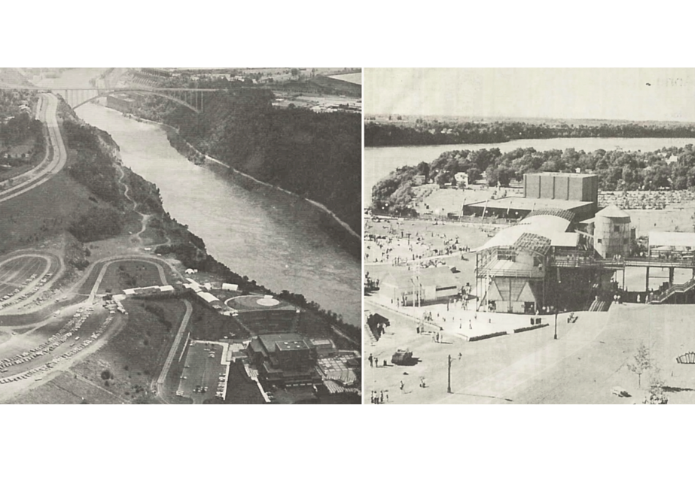
These early aerial photographs reveal the landscape and architecture that gave birth to Artpark’s cultural experiments.
When ONNA set out to create a collaboration between plants and composers, Artpark offered the rare setting where both could be heard clearly. Artpark in Lewiston, NY, is a place where cliffs rise around you, the river flows with its own steady rhythm, and the ground is layered with history. Long before ONNA stepped into its creative flow, the land had been inspiring those who graced it for centuries.
Beneath the trails and river overlooks lies rock formed more than four hundred million years ago, when this land rested beneath a warm, shallow sea. Fossils of corals, trilobites, brachiopods, and other ancient marine life still appear in the layered walls of the Niagara Gorge. Thirteen thousand years ago, the original brink of Niagara Falls stood exactly where Artpark sits today. Ancient rivers and ice sheets carved the gorge over thousands of years, gradually guiding the falls southward to their present location.
The wildflowers and trees rise over a burial ground of the Hopewell people, an ancient culture that thrived between 200 B.C.E. and 500 C.E. One of their earthworks, dating to around 160 A.D., rests within the park as part of a widespread network of ceremonial mounds across the Midwest, places that held community, ceremony, and reverence for more than two thousand years.

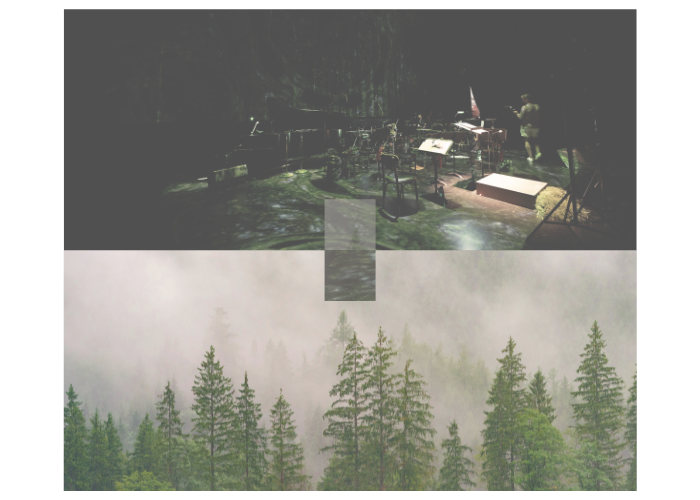
A botanical thread meets the stage: this collage juxtaposes the delicate structure of leaves with musicians from ONNA’s Secret Symphony of Plants performance at Artpark.
Today, Artpark is both a cultural hub and an ecological refuge. Established in 1974 as a collaboration between New York State Parks and Artpark and Company, the grounds were transformed from land previously altered by hydroelectric development into a public arts space unlike anything that had come before. What was once an industrial dumping site is now 150 acres devoted to creativity, performance, sculpture, and open-air experimentation.

A vintage postcard captures the rapids just north of Artpark, reminding us of the river’s untamed history.
Artpark sits within the Niagara River Corridor, a region recognized internationally as both a Globally Significant Important Bird Area and a Ramsar Wetland of International Importance. The river has become a refuge for more than forty species of waterbirds, drawing one of the continent's largest gatherings of gulls and raptors. More than 450 plant and animal species move through the surrounding woods, meadows, cliffs, and wetlands. It's a place that encourages you to look closer as foxes move through the grass, and the songbirds change their path with each season.
This abundance reflects centuries of strength, but it is a reminder that even thriving landscapes rely on a balance that can change without warning. The Niagara River has spent decades recovering from industrial contamination, shoreline alteration, and habitat loss. Artpark and New York State Parks restoration work has improved water quality and revived ecosystems, yet many species remain vulnerable, with small environmental shifts adding pressure to their habitats. Warmer climates, invasive species, and fluctuating water levels continue to disrupt the harmony they depend on. The more closely we pay attention and listen, the clearer it becomes what we're choosing to protect.

Sound rises from water: ripples in the Niagara river pair with a blurred orchestra to echo ONNA’s plant symphony at Artpark.
Artists from around the world have been drawn to the dramatic scenery and deep history of the Niagara River Gorge, filling Artpark with theater, dance, visual art, cirque, music, festivals, and bold new forms of expression. This act of reclamation became an early gesture toward renewal, inviting people to make and experience art beside cliffs, moving water, and a sky so open it welcomes every creative possibility. From its earliest seasons, Artpark became a haven for creators who treated the landscape itself as a collaborator.
Visionary artists such as Agnes Denes, Ree Morton, Pat Oleszko, and Dorothy Hafner were among the first to work here, developing installations, performances, and site-responsive pieces that drew directly from the cliffs, wild grasses, and shifting river light. Laurie Anderson’s boundary‑breaking performance “Stereo Decoy” captures how Artpark has always embraced experimentation; in 1977, she staged a duet with a piano on the Canadian side of the river and a violin on the U.S. side, connecting the two with walkie‑talkies, a bullhorn, and the gorge’s natural acoustics. Their presence helped define Artpark as one of the country's most important spaces for experimental and environmental art, attracting painters, sculptors, performers, conceptual artists, and land artists from around the world. This legacy continues to charm how Artpark evolves today, grounding new projects in a long tradition of creative inquiry that honors the land, its history, and the ecosystems that sustain it.
Artists have long wondered what it might sound like to listen to plants. ONNA carries that curiosity into a new form, offering orchestral interpretations of plant bioelectrical signals influenced by the ecosystem of Artpark and supported by a commitment to conservation. As a regenerative record label, ONNA approaches this work as both artist and producer, creating music that grows in relationship with the land rather than in isolation from it. From Mort Garson's Plantasia to contemporary tools that translate plant activity into sound, ONNA continues to explore how the natural world can inspire music that feels both imaginative and grounded.
The "Secret Symphony of Plants" is an album that grew from this collaboration, inviting listeners to hear the landscape itself as part of the composition. Across Artpark's grounds, the signals from its living plants became a guide for the composers, inviting audiences to experience what can be heard from land that has inspired creativity for millennia. The "Secret Symphony of Plants" became a natural extension of this ecology, a musical project rooted in Artpark's living systems and translated through the bioelectrical language of its plants. While ONNA is not the first to listen, we are humbled to join an ancient conversation by sharing its rhythms in fresh, inspired, and collaborative ways that honor both the land and the stories still carried within it.
Thank you to the composers and everyone at Artpark for contributing your time, creativity, and heart to this project.
